- Data Talks
- What is Statistics?
- Statistical Investigations
- Lies, Lies and Statistics - Statistical Literacy
- Census at School
- Take a Chance - Probability
Thursday, 7 November 2024
MPI - Day 7: Statistics and Probability
Wednesday, 23 October 2024
Literature Review: Strengthen Collaborative Leadership
The review highlights the critical role middle leaders play in bridging the gap between classroom teaching and whole-school leadership, as well as their unique position in improving teaching and learning practices. Reflecting on the insights from the Middle Leadership Review, I recognise that there are FOUR key areas of growth I would like to focus on. Here are the leadership changes I will consider based on the findings:
Strengthen Collaborative Leadership
The review emphasises the importance of middle leaders leading collaboratively and influencing across various levels in the school structure. As a senior leader, I need to foster a culture where middle leaders feel empowered to lead initiatives and collaborate with both their peers and us as SMT. This could involve creating more opportunities for middle leaders to take ownership of key projects, facilitating regular cross-team collaboration, and encouraging shared decision-making.
Focus on Professional Development in Leadership Skills
The research shows that middle leaders require a combination of management and leadership skills, many of which are learned on the job. I would like to prioritise providing targeted professional development that not only focuses on pedagogical improvement but also on leadership and management skills. This could include training on data-driven decision-making, team management, and handling school-wide initiatives. Encouraging middle leaders to engage in reflective practices and leadership courses that align with their specific roles could also be beneficial...now to find some options!
Create Structures for Data-Driven Improvement
Middle leaders play a pivotal role in using data to inform pedagogical practices. I will continue to enable middle leaders have access to the necessary data as easily as possible, which I think I have been doing well for a while now. However, in our meetings I need to facilitate regular data discussions and create a culture where data is used consistently to drive teaching improvements. This should then have a flow on effect to help student outcomes and enable middle leaders to lead with greater impact.
Foster Innovation and Improvement
Middle leaders are well-positioned to lead innovation and change within schools. My leadership approach needs to encourage a forward-thinking mindset by providing the freedom and resources for middle leaders to experiment with new teaching methods, technologies, and programs. Supporting a culture of continuous improvement will inspire middle leaders to drive positive change within their teams.
Effective middle leadership is dependant on strong support from senior leadership. As an associate principal, my role is to provide the necessary scaffolding, mentorship, and professional development to ensure middle leaders thrive. By refining my leadership approach in these areas, I hope to help middle leaders become more successful in their leadership and in turn create greater impact in the life of our school and the impact that we can have on learner outcomes.
Thursday, 17 October 2024
MPI - Day 7: Geometric Thinking
- Quick Images (Subitising)
- What is Geometry?
- 2D Shapes and Angles
- 3D Shapes
- Transformation and Symmetry
- Pathways: Position and Orientation
Thursday, 19 September 2024
MPI - Day 6: Number through Measurement
- Beginning multiplicative thinking
- Multiplicative Thinking: Fractions and Decimals
- Exploring length, perimeter and area
- Measurement: Volume and Capacity
- Measurement: Triangles and Angles
Today has really got me thinking about what our learners need to help them pass the PAT tests (short term) and the prerequisites (long term). It was really interesting to see what questions seemed to stump our year 8 learners. It’s clear that many students find measurement challenging. The key reminder yet again is to keep it interactive—use manipulatives, get students visualising their work, and always tie it back to things they know from the real world! As teachers, it’s up to us to keep building on this and ensure students not only understand the mathematical concepts but also see how maths applies to their everyday lives.Thursday, 29 August 2024
MPI - Day 5: Algebraic Thinking
- Early algebraic thinking
- Symbols and Expressions
- Number Properties
- Equations, Patterns and Relationships
- Variables and Linear relationships
This got me thinking about how important it is to use a scaffolded approach - where learners progress through stages and can deepen their understanding of patterns and relationships. This gradual progression is crucial in helping learners transition from concrete to abstract mathematical thinking, just like in other maths domains, but in my opinion it's even more important. This is because algebra can be so much more scary for learners who aren't used to the vocab or used to the notation of algebra.
Once again, the integration of real-life applications and visual aids are needed (even more so than basic number examples) to help enhance comprehension and making abstract ideas more tangible for learners.
I have also been reflecting during this afternoon on teaching variables to kids here at PES. It got me thinking on the struggle they may have with the shift from arithmetic to algebraic thinking, so patience and continuous reinforcement will be key here. Especially breaking down the idea that a variable is just a symbol that can represent different values and why we might need this or find it helpful.
Tuesday, 27 August 2024
2024 Professional Growth Cycle Goal
- in their role
- to facilitate team meetings focussed on strategic goals
- to create long term integrated plans
- in analysis of student achievement data
- to know if teachers are making a difference to student progress and achievement
- to support teachers to reflect on their practice and improve practice
- ensuring that knowledge to improve learning is built and shared
- ensuring that problems impeding learning and wellbeing in the area are identified and resolved
An essential part of my leadership this year is fostering collaboration, encouraging collective responsibility for achieving our shared goals. Additionally, focusing on mental health/wellbeing and improving attendance will be key to addressing barriers to student learning.
As I continue to mentor and coach team leaders, I aim to develop their capacity to interpret data, lead discussions on student progress, and support their teams in making a tangible difference in student achievement. Moving forward, I will reflect on my own leadership practices to ensure that I provide the support needed for team leaders to accelerate student progress and maintain healthy, productive relationships within their teams.
Thursday, 8 August 2024
MPI - Day 4: Number
Today's focus was on knowing and understanding our learners as Mathematicians. We looked at the following areas:
- Maths Talks
- Understanding Place Value
- Fractions as a Number
- Fractions as Operators
- Decimals and Percentages
- Integers - Positive and Negative Numbers
Thursday, 6 June 2024
MPI - Day 2: Know your learners as Mathematicians
Today's focus was on knowing and understanding our learners as Mathematicians. We looked at the following areas:
- What makes a confident maths teacher?
- Assessment 101
- Keeping track of learning
- Assessment Data and Planning
- Developing assessment capable learners
- Tracking Maths Profiles
We need to have a deep understanding of mathematical concepts ourselves. This will allow us to explain ideas clearly and answer student questions effectively. It's also critical for us to be able to guide learners through their next steps and provide them with effective feedback.
A growth mindset:
If we truly want maths to be enjoyable (which evidence suggests that learners produce the best outcomes when enjoyment is part of the learning), then we as teachers need to portray maths as an interesting and engaging subject. We need to foster a love of learning and reflect this in out teaching style in such a way that allows learners to enjoy the challenge that maths can provide.
Create a supportive environment:
We were encouraged today that we need to create a safe space where mistakes are seen as a natural part of the learning process, encouraging students to take risks and persevere.
Assessment as a means to track and build next learning steps:
We were given a teacher workbook to use for planning and tracking of learners current/next steps. This is a great resource. It has led me to think around how this could neatly fit into what we are already doing as a school and how we can adjust to fit in with the HERO learning intentions, etc...
Today was very thought provoking and an excellent reminder of what we can do to become the best maths teachers for our amazing learners.
Thursday, 16 May 2024
MPI - Day 1: Mathematics is Core
Today's first MPI session was a really impactful day looking at the following areas:
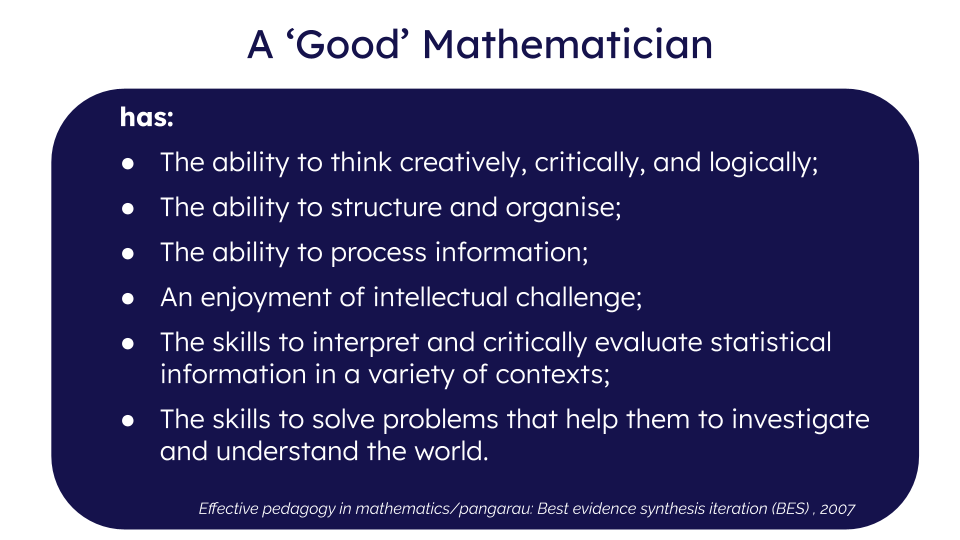
1. What Characterises a ‘Good Mathematician’?
2. The Idea of Teachers as Mathematicians
3. Mathematics Across the Curriculum
4. Using extended discussion in maths
5. How to Grow ‘Good Mathematicians’
A Good Mathematician
Some of the following things have stuck out for me today. Firstly, thinking deeply into what makes a 'Good Mathematician' was challenging. As teachers we often think that it's those kids who can answer questions quickly and correctly is what makes a good mathematician. However, today we were challenged that it's our learners ability to think creatively and critically and logically. Also, it's their ability to enjoy an intellectual challenge and to relish the struggle of finding a solution; both individually and as part of a group.
Something that was impactful to me was the concept of finishing quickly. "Many people incorrectly believe that being good at maths means being fast at maths. It doesn’t - and we need to disassociate maths from speed." This is so true. Often it is in the quiet, slow wrestle of a problem that gold can be found!
Maths is a Visual Subject
Secondly, the idea that maths is a visual learning area really hit home! "Maths is to think visually and creatively and make connections. Not just about calculating" Teachers help students become mathematicians when they believe everyone can learn maths at high levels and that the maths is visual.I read a small research paper called, "Seeing as Understanding: The Importance of Visual Mathematics for our Brain and Learning: by Jo Boaler, Lang Chen, Cathy Williams and Montserrat Cordero. This explains that visual processing is an important part of how our brains learn maths, even at higher levels. Using visual aids and manipulatives can help students of all ages understand maths concepts more deeply. It argues that the old approach to teaching maths (an abstract approach) can make maths more difficult for students to learn and can discourage them from pursuing maths further. This is incredibly freeing for teachers to know that it's not just for struggling learners or for younger aged learners. This is for all learners and all topics!
Really looking forward to the next session!
Wednesday, 13 November 2019
Thursday, 20 June 2019
DMIC PD 4 - Part 1:
- making connections with ideas
- open-ended? require complex problem solving?
- have multiple entry points? have multiple opportunities for Ss to demonstrate intellectual competence?
- require positive interdependence (working together)? fostering individual accountability?
- Ss should not be grappling with both difficult numbers and unfamiliar contexts
- should be grappling with difficult numbers/familiar context OR difficult context/more familiar numbers
Thursday, 6 June 2019
Google Spreadsheets: Creating Your Own Formula
I have found that there are thousands of people worldwide who are creating cool scripts and formulas to upgrade the functionality and use-ability of Google Spreadsheets - so Google it and find their awesomeness!
Watch the following 'How To' to show you how you can create your own formula for Google Spreadsheets and how I use a particular formular that I love: 'Count Coloured Cells'.
Wednesday, 8 May 2019
Google Spreadsheets: Using COUNTA and COUNTIF
What I hate with these types of sheets is not being able to know at a glance - especially when they get large like our year 5&6 camp (around 150 kids) you can't tell easily how many kids you need to follow up. So I use the two formulas to do this for me: COUNTA and COUNTIF.
Check out this screen recording to learn how to do it.
Monday, 6 May 2019
Reading PD: Agility with Sound - Helen Squires
Running Records
Clarification around Teacher Told:
A = AppealY = "You Try"
TA = Try Again
Give them 5-10s wait time. If they still aren't sure you can tell them. Mark this word with a T = Teacher told. This will be worth 1 error.
Analysing Errors - MSV
We then worked in pairs to analyse a running record to work out what they did to get things wrong.1. Meaning (M): Does the reader’s error make sense based on the meaning of the pictures or the story? For example, maybe the child read the word happy instead of glad.
2. Structure/Syntax (S): Does the reader’s error follow the rules of grammar and the structure of sentences in the English language? For example, maybe the child read jumps instead of jumped. In this case, the error may sound right.
3. Visual (V): Is the reader’s error visually similar to the word on the page? For example, the reader may read even instead of every.
Agility with Sound
Friday, 12 April 2019
TOD: Quantities of Quality Text - Jannie van Hees
Words have Power - Quantities of Quality Text:
Both spoken and reading/writing text. More books means that there is going to be more:
- contexts
- concept knowledge
- vocabulary - language that won't otherwise be in children's lives
- conversations that apply to the above are super important - produce thinking and meaning.
- Language structures
- Attention to and noticing
- focus and notice
- put in the effort
- fully participate
- push myself to the edge
- dig deep for what I already know
- learn from others
- I share
- think and talk; think and read
- wondering and asking
Sources of language:
- spoken
- written
- variety of contexts
- loving reading
- reading together
DMIC PD 3: Complexity of Instruction
Complex Instruction
Through DMIC We are only changing how we deliver maths not the maths content - it's a pedagogical change only! It's about creating a different image of what it means to understand a mathematical idea. Can we truly develop ourselves as teachers to create children who are confident in maths even if they believe they aren't 'good' at maths?
Assigned Status & Value
Through the focus of social and academic status - we raise the status of children's mathematical contributions. Affirming them within their own knowledge and understanding. Creating a relationship that is reciprocal but also safe and that our children understand that they are loved. This will always result in children learning and learning with passion and drive.
This builds on the idea that learning is complex, and that learners will make sense of the learning challenge it presents in multiple ways, but only if we step back. But only to a point - we still need to be in control of scaffolding kids, helping to direct the sharing/conversation portion of a lesson, etc.
Anxiety: By giving children the opportunity to know that we are going to ask them for their thinking, they can feel safer that their turn is coming rather than sitting waiting anxiously for their turn and then it never arrives. Could and should we tell them when we are not going to ask them??
Status is local and changes within settings. Often what is seen in the classroom reflect status' seen in society. I wonder if we can help redefine these for a new generation?? Children watch how we interpret things and our actions and wait to see what we value. We need to be more obvious and overt to assign value to children across our classrooms.
Status of children in small groups shape who talks first or who's opinion is listened and used more often. So what does this look like practically in the classroom? How do teachers actually do this?
Equitable Teaching Practices
Jo Boaler - How a Detracked Mathematics Approach Promoted Respect, Responsibility, and High Achievement
- How do we implement this into our classroom practice?
- What do our children learn through this?
- How do we develop this in our classrooms?
Wednesday, 10 April 2019
Pt England Ambassadors @ MIT - 2019
- our children are hooking into learning because of a real audience
- they are passionate learners
- our children are learning in a VERY different way to other learners in other schools
- if you give our children a stage, they take it with two hands! Our children lifted hugely in their presentation because of the large crowd today and they lifted more when the crowd were responsive
Thursday, 4 April 2019
Google Drawings: Creating Info-Graphics
Thursday, 28 March 2019
DFI Presenting: Otaki....Remotely!
As always I enjoyed working with Vicki and her team. They are an awesome bunch who are passionate about their teachers and learners, who they serve. I am always left so inspired working with these guys and learning from their expertise in Te Reo Māori!
Some key thoughts from this session:
- what policies and procedures do you need to have place to be able to 'go live' in the classroom
- what CAN you live stream and what SHOULD you live stream?
- what should you stream via delayed coverage?
Wednesday, 20 March 2019
Google Spreadsheets: Data Analysis Using VLOOKUP
A few years ago as part of my inquiry into teaching I had been looking into ways I could better use assessment to inform my next teaching steps, especially to jump on opportunities sooner. However, when ever I got anywhere near formative data it was spread out across a range of different places -
e-asTTle, NZCER, etc. I needed an easy way to collect this data. Aha! Use a spreadsheet someone told me. However this meant doing hours of copy and paste from other spreadsheets to then have it collated in mine!
This lead me to look at using some of the features of spreadsheets. By using a simple VLOOKUP formula I have been able to set up each sheet to go looking for data for me. There is no more need to copy and paste a whole lot of information anymore!
Check out the below screencast of me explaining the setup of a spreadsheet and how this has streamlined my data gathering and analysis.
.png)
.png)

.png)
.png)

.png)
.png)

.jpg)
%20(2).jpg)

.png)