- Data Talks
- What is Statistics?
- Statistical Investigations
- Lies, Lies and Statistics - Statistical Literacy
- Census at School
- Take a Chance - Probability
Thursday, 7 November 2024
MPI - Day 7: Statistics and Probability
Thursday, 17 October 2024
MPI - Day 7: Geometric Thinking
- Quick Images (Subitising)
- What is Geometry?
- 2D Shapes and Angles
- 3D Shapes
- Transformation and Symmetry
- Pathways: Position and Orientation
Thursday, 19 September 2024
MPI - Day 6: Number through Measurement
- Beginning multiplicative thinking
- Multiplicative Thinking: Fractions and Decimals
- Exploring length, perimeter and area
- Measurement: Volume and Capacity
- Measurement: Triangles and Angles
Today has really got me thinking about what our learners need to help them pass the PAT tests (short term) and the prerequisites (long term). It was really interesting to see what questions seemed to stump our year 8 learners. It’s clear that many students find measurement challenging. The key reminder yet again is to keep it interactive—use manipulatives, get students visualising their work, and always tie it back to things they know from the real world! As teachers, it’s up to us to keep building on this and ensure students not only understand the mathematical concepts but also see how maths applies to their everyday lives.Thursday, 29 August 2024
MPI - Day 5: Algebraic Thinking
- Early algebraic thinking
- Symbols and Expressions
- Number Properties
- Equations, Patterns and Relationships
- Variables and Linear relationships
This got me thinking about how important it is to use a scaffolded approach - where learners progress through stages and can deepen their understanding of patterns and relationships. This gradual progression is crucial in helping learners transition from concrete to abstract mathematical thinking, just like in other maths domains, but in my opinion it's even more important. This is because algebra can be so much more scary for learners who aren't used to the vocab or used to the notation of algebra.
Once again, the integration of real-life applications and visual aids are needed (even more so than basic number examples) to help enhance comprehension and making abstract ideas more tangible for learners.
I have also been reflecting during this afternoon on teaching variables to kids here at PES. It got me thinking on the struggle they may have with the shift from arithmetic to algebraic thinking, so patience and continuous reinforcement will be key here. Especially breaking down the idea that a variable is just a symbol that can represent different values and why we might need this or find it helpful.
Thursday, 8 August 2024
MPI - Day 4: Number
Today's focus was on knowing and understanding our learners as Mathematicians. We looked at the following areas:
- Maths Talks
- Understanding Place Value
- Fractions as a Number
- Fractions as Operators
- Decimals and Percentages
- Integers - Positive and Negative Numbers
Thursday, 6 June 2024
MPI - Day 2: Know your learners as Mathematicians
Today's focus was on knowing and understanding our learners as Mathematicians. We looked at the following areas:
- What makes a confident maths teacher?
- Assessment 101
- Keeping track of learning
- Assessment Data and Planning
- Developing assessment capable learners
- Tracking Maths Profiles
We need to have a deep understanding of mathematical concepts ourselves. This will allow us to explain ideas clearly and answer student questions effectively. It's also critical for us to be able to guide learners through their next steps and provide them with effective feedback.
A growth mindset:
If we truly want maths to be enjoyable (which evidence suggests that learners produce the best outcomes when enjoyment is part of the learning), then we as teachers need to portray maths as an interesting and engaging subject. We need to foster a love of learning and reflect this in out teaching style in such a way that allows learners to enjoy the challenge that maths can provide.
Create a supportive environment:
We were encouraged today that we need to create a safe space where mistakes are seen as a natural part of the learning process, encouraging students to take risks and persevere.
Assessment as a means to track and build next learning steps:
We were given a teacher workbook to use for planning and tracking of learners current/next steps. This is a great resource. It has led me to think around how this could neatly fit into what we are already doing as a school and how we can adjust to fit in with the HERO learning intentions, etc...
Today was very thought provoking and an excellent reminder of what we can do to become the best maths teachers for our amazing learners.
Thursday, 16 May 2024
MPI - Day 1: Mathematics is Core
Today's first MPI session was a really impactful day looking at the following areas:
1. What Characterises a ‘Good Mathematician’?
2. The Idea of Teachers as Mathematicians
3. Mathematics Across the Curriculum
4. Using extended discussion in maths
5. How to Grow ‘Good Mathematicians’
A Good Mathematician
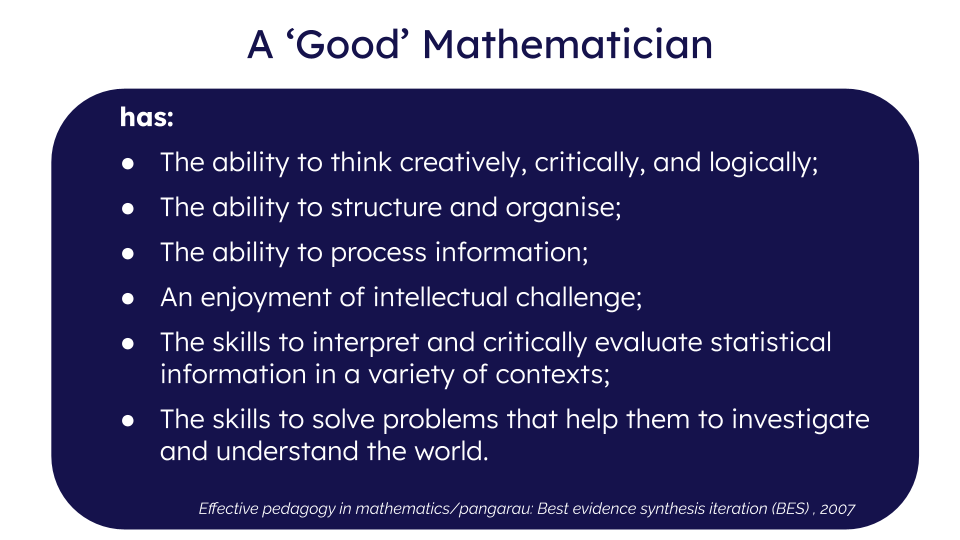
Some of the following things have stuck out for me today. Firstly, thinking deeply into what makes a 'Good Mathematician' was challenging. As teachers we often think that it's those kids who can answer questions quickly and correctly is what makes a good mathematician. However, today we were challenged that it's our learners ability to think creatively and critically and logically. Also, it's their ability to enjoy an intellectual challenge and to relish the struggle of finding a solution; both individually and as part of a group.
Something that was impactful to me was the concept of finishing quickly. "Many people incorrectly believe that being good at maths means being fast at maths. It doesn’t - and we need to disassociate maths from speed." This is so true. Often it is in the quiet, slow wrestle of a problem that gold can be found!
Maths is a Visual Subject
Secondly, the idea that maths is a visual learning area really hit home! "Maths is to think visually and creatively and make connections. Not just about calculating" Teachers help students become mathematicians when they believe everyone can learn maths at high levels and that the maths is visual.I read a small research paper called, "Seeing as Understanding: The Importance of Visual Mathematics for our Brain and Learning: by Jo Boaler, Lang Chen, Cathy Williams and Montserrat Cordero. This explains that visual processing is an important part of how our brains learn maths, even at higher levels. Using visual aids and manipulatives can help students of all ages understand maths concepts more deeply. It argues that the old approach to teaching maths (an abstract approach) can make maths more difficult for students to learn and can discourage them from pursuing maths further. This is incredibly freeing for teachers to know that it's not just for struggling learners or for younger aged learners. This is for all learners and all topics!
Really looking forward to the next session!
.png)
.png)
.png)
.png)

.png)
.png)
.jpg)
%20(2).jpg)

.png)


