Thursday, 16 May 2024

MPI - Day 1: Mathematics is Core

Today's first MPI session was a really impactful day looking at the following areas:

1. What Characterises a ‘Good Mathematician’? 

2. The Idea of Teachers as Mathematicians

3. Mathematics Across the Curriculum

4. Using extended discussion in maths

5. How to Grow ‘Good Mathematicians’

A Good Mathematician

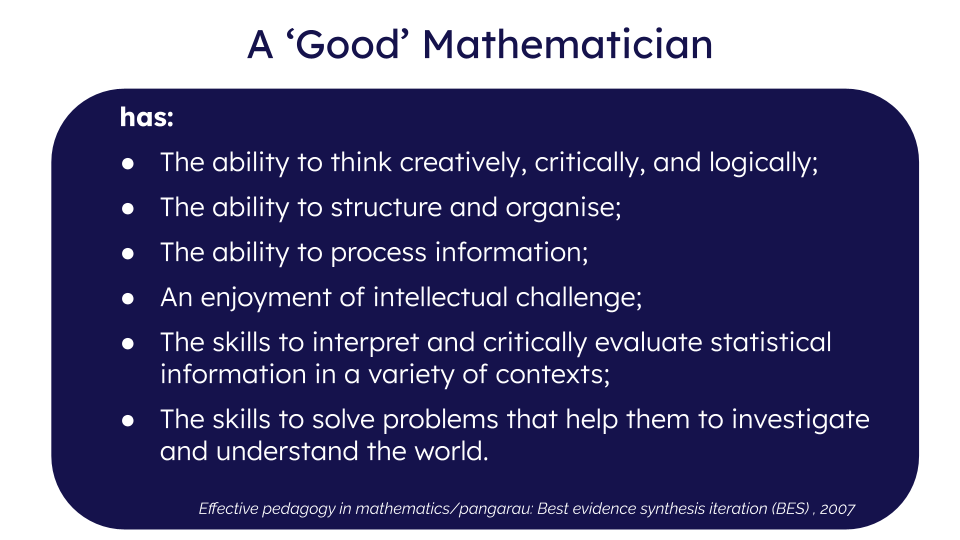
 Some of the following things have stuck out for me today. Firstly, thinking deeply into what makes a 'Good Mathematician' was challenging. As teachers we often think that it's those kids who can answer questions quickly and correctly is what makes a good mathematician. However, today we were challenged that it's our learners ability to think creatively and critically and logically. Also, it's their ability to enjoy an intellectual challenge and to relish the struggle of finding a solution; both individually and as part of a group. 
Something that was impactful to me was the concept of finishing quickly. "Many people incorrectly believe that being good at maths means being fast at maths. It doesn’t - and we need to disassociate maths from speed." This is so true. Often it is in the quiet, slow wrestle of a problem that gold can be found!


Maths is a Visual Subject

Secondly, the idea that maths is a visual learning area really hit home! "Maths is to think visually and creatively and make connections. Not just about calculating" Teachers help students become mathematicians when they believe everyone can learn maths at high levels and that the maths is visual. 

I read a small research paper called, "Seeing as Understanding: The Importance of Visual Mathematics for our Brain and Learning: by Jo Boaler, Lang Chen, Cathy Williams and Montserrat Cordero. This explains that visual processing is an important part of how our brains learn maths, even at higher levels. Using visual aids and manipulatives can help students of all ages understand maths concepts more deeply. It argues that the old approach to teaching maths (an abstract approach) can make maths more difficult for students to learn and can discourage them from pursuing maths further. This is incredibly freeing for teachers to know that it's not just for struggling learners or for younger aged learners. This is for all learners and all topics!

Really looking forward to the next session!

Thursday, 20 June 2019

DMIC PD 4 - Part 1:

Today we took part in DMIC PD session 4 (part 1) with Don Biltcliff. Below are some notes of this session - thanks Kiriwai!

Presentation

Readings


Take a leap of faith with problems given to kids, need to believe in what the kids can do - whether they get it right or wrong is not as important  as seeing what the kids can do - step back from pre-teaching

Go for harder problems/to push kids thinking  - this forces kids to use different strategies that may not be evident with ‘easier’ problems


Thinking like a Mathematician - moving past computational aspect of solving maths problems
  • making connections with ideas

If Ss will not grow if always being shown what to do -  Ss benefit if they work on problems that they have not been shown how to solve and need to explain to others their own strategies


Think about your Tasks:
Are the tasks you use:
  • open-ended? require complex problem solving?
  • have multiple entry points? have multiple opportunities for Ss to demonstrate intellectual competence?
  • require positive interdependence (working together)? fostering individual accountability?

Group worthy tasks

Culturally Responsive Tasks

  • Ss should not be grappling with both difficult numbers and unfamiliar contexts
  • should be grappling with difficult numbers/familiar context OR difficult context/more familiar numbers

Thursday, 6 June 2019

Google Spreadsheets: Creating Your Own Formula

There have been a few times now that I have wanted to do something in Google spreadsheets that I know exist in Excel. However, that functionality doesn't exist yet in Google. So my answer....make it yourself.

I have found that there are thousands of people worldwide who are creating cool scripts and formulas to upgrade the functionality and use-ability of Google Spreadsheets - so Google it and find their awesomeness!

Watch the following 'How To' to show you how you can create your own formula for Google Spreadsheets and how I use a particular formular that I love: 'Count Coloured Cells'.

Wednesday, 8 May 2019

Google Spreadsheets: Using COUNTA and COUNTIF

There are many times that I need to create a spreadsheet that houses the organisation of school wide events like Fiafia or even a camp. One of these sheets that I create often is a payment sheet to track who has paid, who has handed in their permission/ medical forms and if I have emergency contact details for any child.

What I hate with these types of sheets is not being able to know at a glance - especially when they get large like our year 5&6 camp (around 150 kids) you can't tell easily how many kids you need to follow up. So I use the two formulas to do this for me: COUNTA and COUNTIF.

Check out this screen recording to learn how to do it.

Monday, 6 May 2019

Reading PD: Agility with Sound - Helen Squires

Today in our staff meeting Helen Squires went over Running Record Conventions and what to do next with the information that you get from a Running Record. She also shared with us her expertise using Agility with Sound - created by Betsy Sewell.

Running Records


Clarification around Teacher Told:

A = Appeal
Y = "You Try"
TA = Try Again
Give them 5-10s wait time. If they still aren't sure you can tell them. Mark this word with a T = Teacher told. This will be worth 1 error.

Analysing Errors - MSV

We then worked in pairs to analyse a running record to work out what they did to get things wrong.

Following information comes from: This Reading Mama
1. Meaning (M): Does the reader’s error make sense based on the meaning of the pictures or the story? For example, maybe the child read the word happy instead of glad.

2. Structure/Syntax (S): Does the reader’s error follow the rules of grammar and the structure of sentences in the English language? For example, maybe the child read jumps instead of jumped. In this case, the error may sound right.

3. Visual (V): Is the reader’s error visually similar to the word on the page? For example, the reader may read even instead of every.


Agility with Sound

Children are given a list of words where they have to interact with them. Firstly they highlight any words with 'a' vowel sound or 'u' vowel sound, etc. Then you find out how many they got in a minute. The idea of this is to build their ability to see and hear the correct vowel sounds.

This programme is full of lots of word work! For example - 'GUB': "how do we turn this into Grub?" "Where does the R go?" The idea is to build from one letter up progressing through to building from words.


Friday, 12 April 2019

TOD: Quantities of Quality Text - Jannie van Hees

Today as part of our teacher only day we had Jannie van Hees come and talk to us about the power of words and Quantities of Quality Text. Below are some of my notes and key take aways from this session.

Words have Power - Quantities of Quality Text: 
Both spoken and reading/writing text. More books means that there is going to be more:
  • contexts
  • concept knowledge
  • vocabulary - language that won't otherwise be in children's lives
  • conversations that apply to the above are super important - produce thinking and meaning.
  • Language structures

Teachers just repeating back to kids what they have said is no use. This is already what they know, this is not in the 'Gifting Zone'. Quality text that I can't just do on my own.

Children's ability to acquire and use language is astounding! Are we putting children into this zone as much as possible? The goldilocks zone is where we want children - grappling with text. We need to continually teach our children how to use new language.

Are reading groups making the difference for our 'Reading to Learn' children? Are these providing enough text for our children that is dripping with high powered language. Are they also getting multiple chances and goes at this text?

How are we optimising our learning conditions? 
  • Attention to and noticing
    • focus and notice
    • put in the effort
    • fully participate
    • push myself to the edge
    • dig deep for what I already know
    • learn from others
    • I share
    • think and talk; think and read
    • wondering and asking

Use your words and ideas that gift your learners knowledge and words. Are there a tonne of questions and 'raising hands syndrome' happening in our classrooms? 

Say more. Tell more detail.
Use words and ideas that gift your children knowledge and words. Talk the detail! What is the 'gift' that I am giving the children? What is the lense that I am putting the child's mind onto? The children's writing needs to move away from talk language.


SAY: "Because we are adding more detail we know what you mean" 
NOT: "Write this in a more interesting way!"


I am not going to offer a response that they can repeat - I am wanting to develop their vocabulary use. Talk the detail! We want to get our children out of the lazy zone and make them think. Say and use words so your audience really know what you mean.

Sources of language:
  • spoken
  • written
  • variety of contexts
  • loving reading
  • reading together